Storing digisnaps of places visited and meals eaten, archiving documents, sharing conference materials with colleagues; these days it’s becoming second nature to store all sorts of data in the cloud, where it’s safe until needed—or until it’s forgotten. All this is driving a dramatic expansion in all kinds of data, and it all has to be stored somewhere.
The “cloud” sounds like something far off and insubstantial. In fact, it’s realized by vast arrays of hard disk drives (HDD) in data centers. Their magnetic disks are virtual notebooks where data are recorded, their magnetic head function as pens. Most data center HDD are “nearline” devices, a portmanteau of “near” and “online,” an intermediate between online storage supporting frequent, very high speed access to data, and the offline storage used for back-ups or long-term archiving of infrequently accessed data.
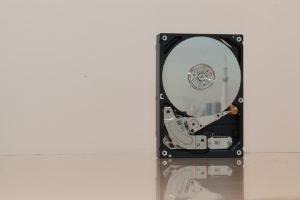
3.5-inch Nearline HDD
As more and more services and much of what we do moves on-line, the volume of data generated every day is only going to increase. Handling it will require bigger clouds, much more storage capacity. One way to achieve that is to simply add servers, and while that has to be part of the solution, it’s also part of the problem, as servers need space, a carefully controlled environment, and consume a lot of power. A better way is to increase HDD capacity. But that’s not quite as easy as it sounds.
Adding more disks to a Nearline HDD is quite a difficult proposition. The disks rotate at 7200 rpm, and simply adding more of them raises issues of energy consumption, and questions of durability and reliability. There’s also the problem of space. HDDs are made to an industry standard, to fit into servers, and there is basically no room to add more.
Given all this, it’s no exaggeration to say that the December 2017 announcement of a nine-disk, 14-terabyte HDD by Toshiba Electronic Devices & Storage Corporation really got the storage industry’s attention. The Toshiba Corp. subsidiary’s drive was the world’s first[1] enterprise Conventional Magnetic Recording (CMR) HDD to reach 14TB, and the first with nine disks, one more than achieved before; it was also filled with helium, not air.
In fact, helium was the key to the innovation. The second lightest gas, it lowered disk resistance, improved performance and contributed to the capacity increase. It also helped to improve power consumption by over 40% compared to previous models. All these technology advances were achieved while maintaining the mean time to failure[2] at 2.5 million hours.
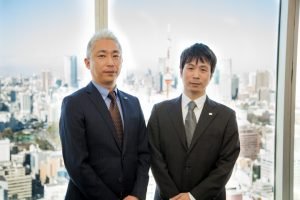
To find out more about this impressive HDD and its innovations, we spoke to Masafumi Fujimori of Toshiba Electronic Devices & Storage Corporation’s HDD Sales & Marketing Div., and Sato Takumi of the HDD Products Engineering Dept.
Q. What are the standout points of the 14TB HDD?
Mr. Fujimori: There are two things that captured attention. First, it’s the world’s first CMR drive with nine disks, and it delivers 14TB capacity. Second, it’s the first Toshiba HDD to replace air with helium.
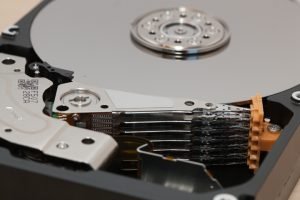
High-density assembly design, showing a 6-disk model.
Q. What’s the reaction to the new product?
Mr. Fujimori: We got a great response from popular technology analysts. We’ve started sample deliveries to some customers, and its performance is now being evaluated.
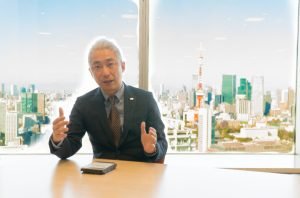
Masafumi Fujimori, Storage Products Div., Toshiba Electronic Devices & Storage Corporation
Q. Is it innovative to squeeze nine disks into a hard drive?
Mr. Sato: Yes. And achieving that really increases the capacity. Before this, our largest capacity drive was a 7-disk, 10TB model. The most any other company has achieved so far is eight disks. If you want to mount nine disks in the same housing as an 8-disk drive, it is crucial to scale down parts and eliminate variations in parts. The HDD must also pass strict shock and vibration resistance tests, to confirm reliability. We were able to resolve these problems with know-how and experience we gained in developing 0.85-inch and 1.8-inch HDD.
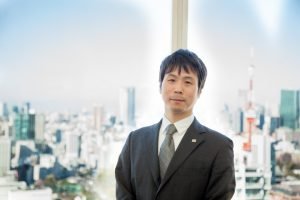
Takumi Sato, Storage Products Div., Toshiba Electronic Devices & Storage Corporation
Q. What’s exactly is helium filling?
Mr. Sato: Until now, our HDD have been filled with air. The 14TB drive replaces it with helium, which has one seventh the density of air.
Q. What benefits does that offer?
Mr. Sato: Quite a lot. First of all, the lower resistance of helium produces less friction and disk vibration, the spin of the disks is more uniform. That cuts energy consumption. The 14TB model consumes 3-watts less energy than our 10TB model, even though it has two more disks. More important, the positional accuracy of the head and see acoustics are improved.
Q. How important is it to reduce HDD energy consumption?
Mr. Sato: Very. The target market for large capacity HDD like our 14TB model is data centers, which use large numbers of drives to store and access data, 24/7, every day of the year. For data center operators, cutting power consumption is a huge concern.
Q. Are there other pluses with the 14TB HDD?
Mr. Sato: Even with more disks, it weighs less than previous products. As with electricity consumption, data centers want to cut weight, and the lower weight of the 14TB drive has won praise from customers.
Q. If helium offers so many benefits, why hasn’t it been used before?
Mr. Sato: Helium is expensive and brings with it a cost disadvantage, and our priority was to secure steady advances in air-type HDD. Our general judgment was to go with air up to 10TB. However, once we reached that point, we decided to develop a helium-filled HDD, because it’s very difficult to get to 14TB HDD with air.
Q. Is it difficult to fill an HDD housing with helium?
Mr. Sato: Yes. Especially when it’s crammed full with nine disks. Our competitors and even some of customers thought we wouldn’t be able to handle it. The fact is, helium atoms are so small, that even the tiniest gap in the seal is a leak. Fortunately, Toshiba Group has really useful experience in sealing lithium-ion batteries, and cultivated cutting-edge technologies for high quality laser welding. We used them to develop reliable HDD housings with no leaks.
Q. Do you think Toshiba has overtaken its rivals in terms of technology?
Mr. Sato: I wish we could say that, but I have no doubt that the tough race to lead development is far from over. But that’s a good thing. It inspires us to do more. We must redouble our own efforts, and remember how important it is to cooperate with our partners who supply main components, such as magnetic heads and disks.
Q. Which markets will you target?
Mr. Fujimori: Data centers. We will develop the market in China, and in small data centers, and, of course, the hyper-scale data centers in the US. Progress in big data is driving an information explosion, and we will have to continue to develop HDD with larger capacities, because data center companies tend to demand the HDD that have the highest capacity at any given time.
40 years ago, there were over 100 companies producing HDDs, but nowadays there are only three, including us. And we are the only Japanese company. I want Toshiba’s technology to continue to contribute to the progress of the cloud.
[1] Source: Toshiba Electronic Devices & Storage Corporation, as of December 8, 2017 for the 3.5-inch, 26.1mm high.
For more details, please visit:
https://toshiba.semicon-storage.com/ap-en/company/news/news-topics/2017/12/storage-20171208-1.html
[2] MTTF (Mean Time to Failure) is not a guarantee or estimate of product life; it is a statistical value related to mean failure rates for a large number of products, and may not accurately reflect actual operation. The actual operating life of the product may be different from the MTTF.