Looking for a Ride Home? Why not try Mobility-as-a-Service
- Highlights
Original article is hosted here.
As vehicle ownership falls and ride hailing and ride sharing services find increasing popularity, powerful forces are making themselves felt in commuter transport. However, recent developments are just a taste of things to come. Spurred by advances in digital know-how, there is growing interest in realizing Mobility-as-a-Service, MaaS.
The ideal of MaaS is the ability to leave home, be picked up by a vehicle almost immediately, and taken to a specified destination by a direct route with no unnecessary detours or unwanted delays. It’s a vision that combines the convenience of a taxi with the utility of bus services—and it sounds almost impossible to achieve. But with recent advances in AI and big data analytics, there are people working to make it happen.
Hirozou Yoshitomi, the President of Tokyo-based JUNPUZI is one of them. His company operates Convenicle, coined from convenient and vehicle, and provides a system dedicated to delivering no-wait, on-demand transport know-how to service operators and local governments across Japan.
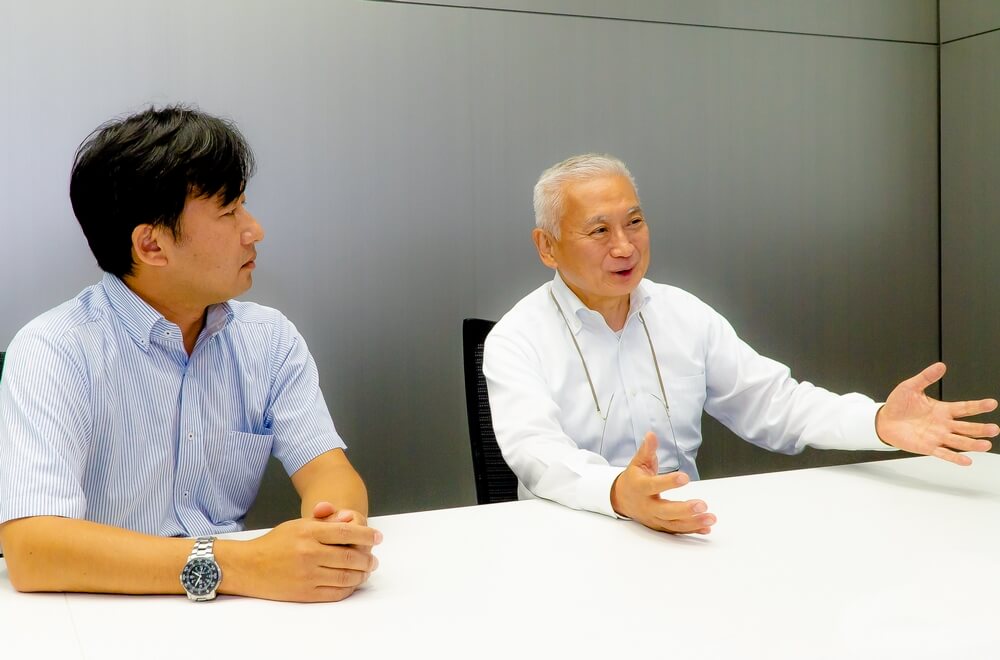
(left) Seiji Kamiya, JUNPUZI’s Project Planning and Development Department Manager
So far, it has been a success. “We are now in our ninth year of operating Convenicle,” Yoshitomi says, “and we currently carry about 70,000 people a month in 42 locations, including Kashiwa City in Chiba Prefecture,” one of Tokyo’s satellite towns. Now the company wants to take this to the next level, and to apply the tools of cutting-edge AI and data analytics to a more advanced MaaS model that can deliver better services. In July 2018, they teamed up with Toshiba to do just that, and develop public transport for tomorrow.
Known first and foremost as a manufacturer, with over 140 years of experience in fields as diverse as turbines and semiconductors, Toshiba has always cultivated other capabilities in parallel. Its research into AI dates back over 50 years, and embraces areas as diverse and demanding as precision imaging and natural language. Today, the company is taking another step forward as a cyber-physical systems technology company, a leader in integrating the physical world of manufacturing and the cyber world of digital know-how.
One area where Toshiba is cultivating expertise is digital transformation, and here a key role is played by “SATLYS™”, an analytics AI based on data analysis and deep learning. Developed, tested and refined by sifting through the vast amounts of data generated by Toshiba’s manufacturing operations, SATLYS works fast to identify, estimate and make predictions. The question for Toshiba was, could it improve on Convenicle?
Just how big was the problem? “The full name is Convenicle, Demand Responsive Transport,” explains Yoshitomi. “The goal is to deliver a public transportation system that operates only when reservations are made.”
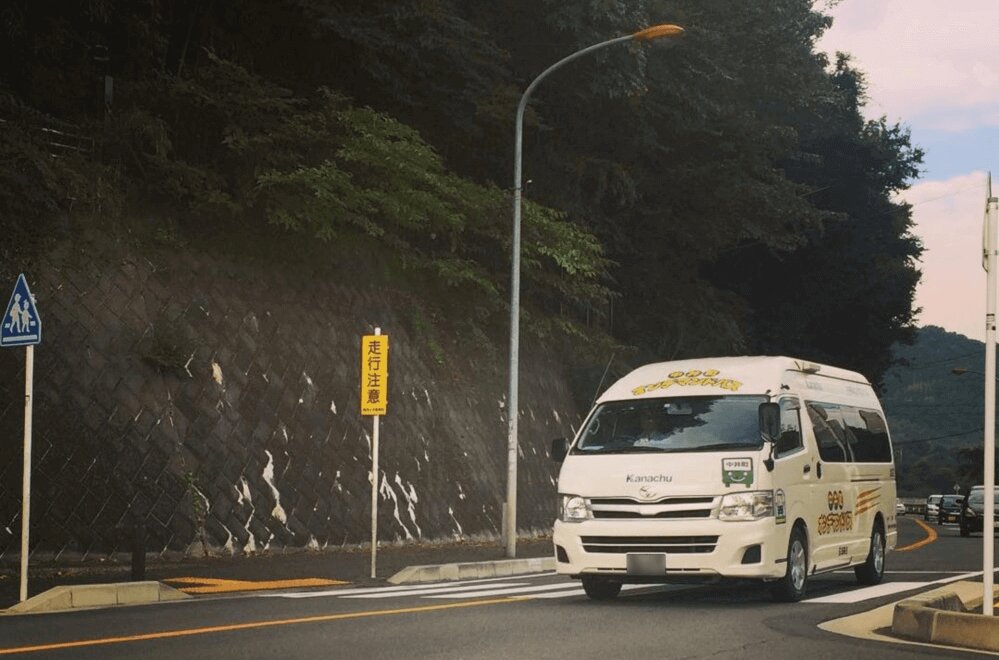
Convenicle service in operation in rural Japan
That introduces one of the most important features of Convenicle, explained by Seiji Kamiya, JUNPUZI’s Project Planning and Development Department Manager. “Buses have set routes, so users often have to make time-consuming and pointless detours, but Convenicle combines multiple reserved pick-up and drop-off points to create routes in the most efficient way, so it’s easy for passengers to use.”
With that approach, every reservation received is another data point, requiring routes and pick-up times to be made and remade to reflect demand. There’s also the question of where passengers get on and off Convenicle. That sounds easy at first, because Japanese streets have numerous garbage collection points, all clearly marked, and they provide convenient pick-up and drop-off points, close to where passengers live—but there are also a lot of them, and that adds to the equation; especially when you want to pick up and drop off people with similar destinations, to maximize capacity utilization.
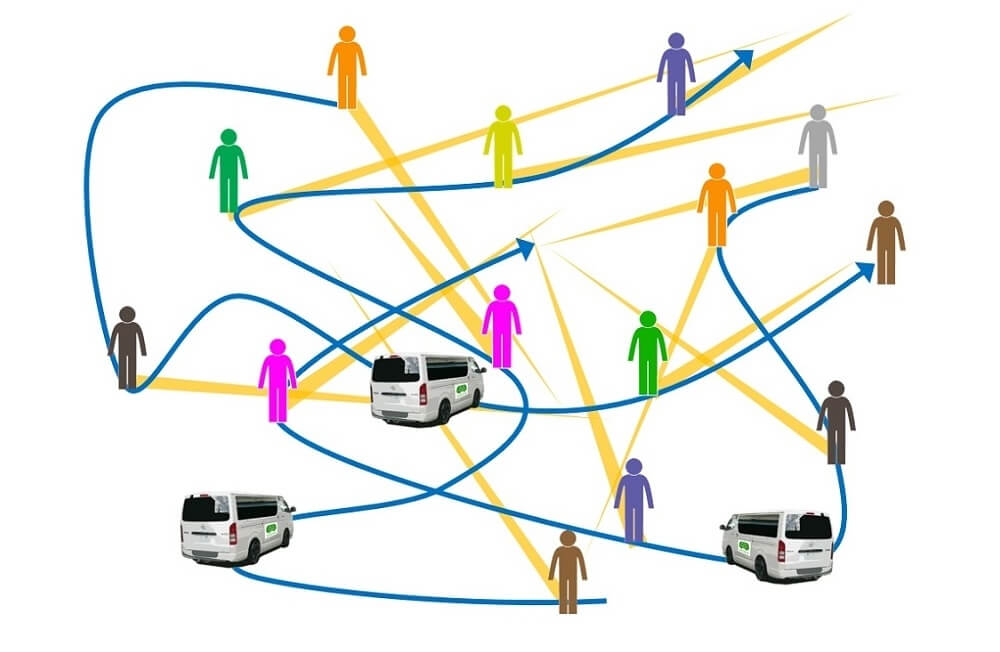
Convenicle route plans. Garbage collection points offer convenient pick-up and drop-off points, and are close to where passengers live.
On top of that, while deep analytics needs data, JUNPUZI had a lot of it: a full nine years of operational data. As Yoshitomi explains, “At the start it really wasn’t clear how we would use operational data, but one thing I was sure of was that it had value. Keep logs. That was our conviction.” And data in those logs had to be put into SATLYS, in one way or another.
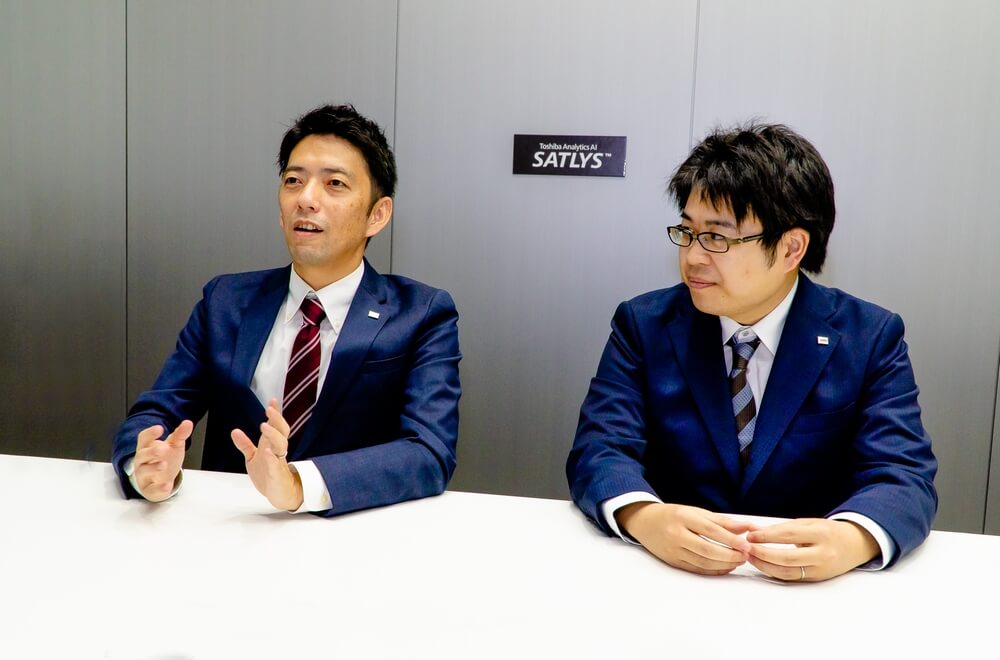
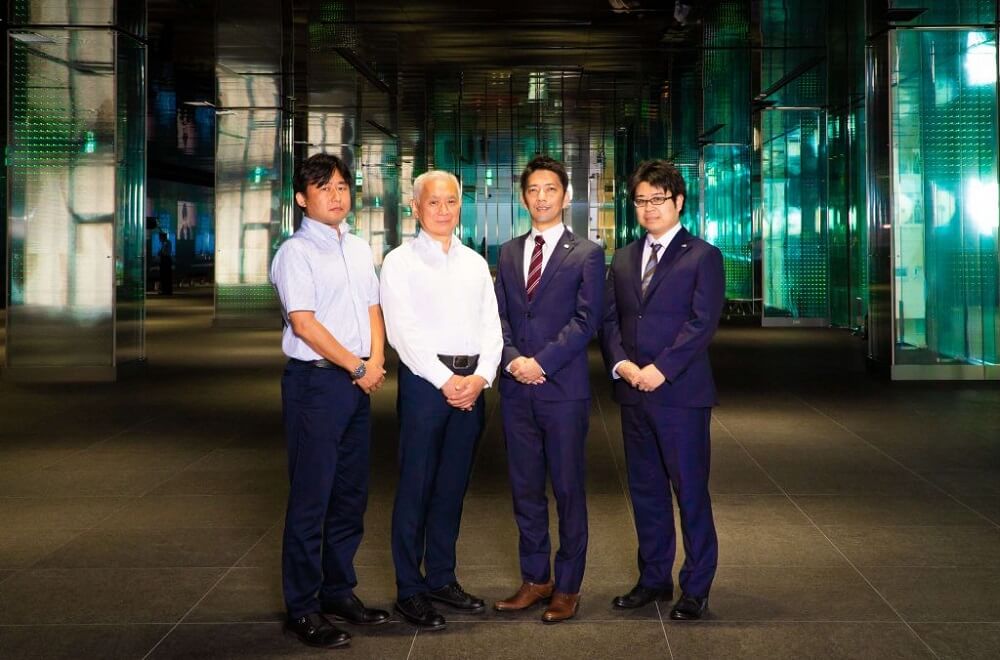
Yuji Irimoto (left) and Hiroki Ueda (right) of Toshiba Digital Solutions Corporation, Software & AI Technology
Hiroki Ueda, a researcher at Toshiba Digital Solutions Corporation, Software & AI Technology Center, describes the scale of the challenge the Toshiba team members faced. “Say you have an area with 2,000 pick-up and drop-off points. You have to process prediction results for all 2,000 pick-up points multiplied by all 2,000 destinations, so you have 4,000,000 potential routes. That’s complex enough. On top of that, there was nine years of data to analyze. Believe me, it gave me a real headache trying to work out how to use this enormous amount of data and find the optimal solutions hidden in it.”
As Ueda recalls, Toshiba initially tried a simpler approach. “As a first step, we showed JUNPUZI the top 100 routes in terms of demand. But in their feedback they told us that it didn’t let them see trends across the entire operational areas” Achieving that was the next goal.
Yuji Irimoto explains how that was done. “SATLYS analyzed Convenicle operation data from JUNPUZI, along with weather data from the Japan Meteorological Agency and information on the characteristics of different days. These covered variables such as, “on rainy days, 20 percent more vehicles are needed in this area,” or “this route takes twice as long on Sundays.”
In the end SATLYS came up with demand predictions for pick-up and drop-off points, times of day and numbers of passengers, for up to several weeks in advance, and produced precise forecasts by comprehensively analyzing and mapping demand. “We analyzed demand in every operating area and plotted it like a heat map, with colors representing demand,” Ueda explains. “From that, we could make forecasts of vehicle demand.” As a result, Toshiba and JUNPUZI have reached a stage where they can use SATLYS to apply knowledge derived from Convenicle toward finding a balance between overall optimization and individual preferences.
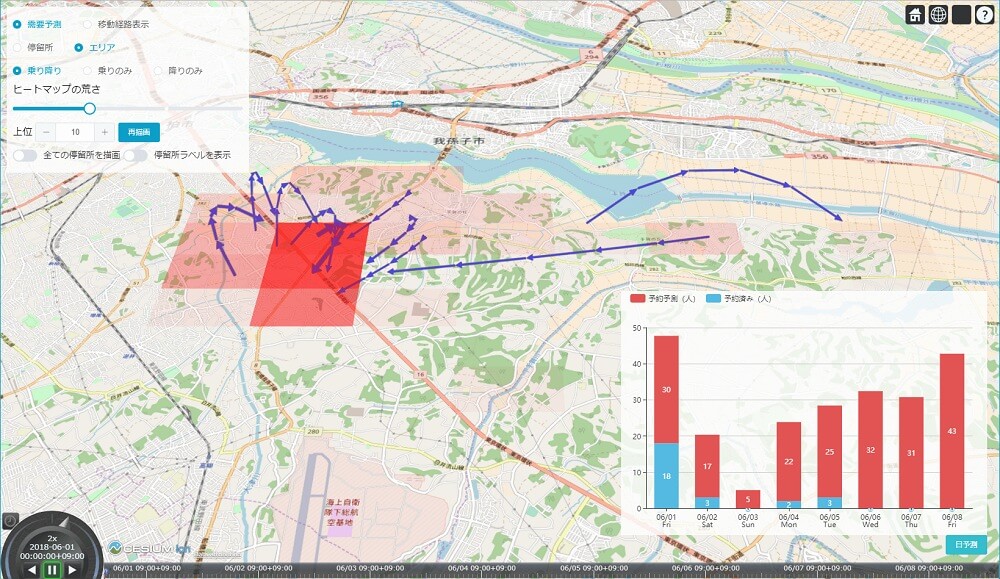
© OpenStreetMap contributors
Kamiya is pleased with the results the collaboration has produced so far, and sees potential for taking the project further. “Using SATLYS to analyze and refine demand forecasts has made managing the Convenicle fleet more efficient. Of course, there are still things to consider, particularly customer feedback. For instance, people have told us they used to ride at a certain time to travel with friends, but route changes have stopped that. We also need to consider factors like that.”
Yoshitomi, JUNPUZI’s president, agrees, and is also thinking about the next step. “We’re not yet at the point where we can say all passengers are equal in terms of efficiency and amenity. Looking ahead, just what is ‘good’ is one of the difficult issues we have to think about.
The Toshiba team is also happy with the progress made. “Implementing this project using the operational data we got from JUNPUZI showed us that Toshiba has the tools needed to do the analysis,” says Irimoto. “Now we will continue to refine the model. We will add more weather and day data, information on local events and regional characteristics.”
Ueda is even more optimistic. “If you say ‘barrier-free,’ I think most people think of physical obstacles to people with physical disabilities. But for some people, being able to move, even 300 meters, can be a barrier. Convenicle, powered by SATLYS, removes barriers to getting about for all of us. This project points the way to the future of transportation, and how to offer people diverse choices in the future.”
As public transport evolves, MaaS has the potential to realize new levels of passenger service and convenience, and the successful collaboration with JUNPUZI positions Toshiba in the vanguard of creating the future of transport services on demand. “Interest in next-generation mobility infrastructure is global, recognized as an urgent requirement,” says Irimoto. “There are many ideas out there, but not many companies have the proven track record of JUNPUZI. I want to continue to work with JUNPUZI, to take on challenges and help to realize the future of transport.”
* SATLYS™ is a registered trademark and/or trademark of Toshiba Digital Solutions Corporation in Japan and other countries.