Speedy Detection of 13 Cancer Types using a Tiny Amount of Blood: microRNA Detection Technology
- Highlights
Original article is hosted here.
On October 19th, 2020, Toshiba’s microRNA detection technology received the honorable CEATEC※1 AWARD 2020 from Minister of Economic, Trade and Industry of Japan. This technology enables very early detection of cancer by measuring the blood concentration of microRNA secreted by cells. The presence of cancer cells results in increased levels of specific microRNA molecules in the blood and Toshiba has developed a unique electrochemical method for detecting these changes. The superiority of this technology is in its detection time and low cost. This article introduces the significance and features of microRNA detection technology along with an interview with the researcher Koji Hashimoto, who developed this remarkable technology.
※1 CEATEC(Combined Exhibition of Advanced Technologies): An international exhibition of IT technology, which aims to contribute to the creation and development of new value and market.
Determining the presence of cancer with microRNA
According to the World Health Organization, cancer is the second leading cause of death globally, and is responsible for an estimated 9.6 million deaths in 2018※2. Globally, about 1 in 6 deaths is due to cancer. In Japan, cancer has been the leading cause of death since 1981, and about 1 in 3.7 people dies due to cancer※3. Ministry of Health Labor and Welfare of Japan is promoting cancer screening tests based on scientific evidence.
※2 Fact sheets of World Health Organization, https://www.who.int/news-room/fact-sheets/detail/cancer
※3 Overview of Monthly and Annual Reports of Demographic Statistics (Approximate Figures): In annual trends in major death causes, cancer consistently increased, ranking No. 1 from 1981 to present.
On the other hand, based on advances in treatment, early detection and treatment of cancer greatly improves survival rates of patients. In the case of lung cancer, the 5-year survival rate for stage II is about 60%, but when it is still at stage 0, it remains at 97%※4. Even if we are affected by cancer, improving survival rate through early detection can contribute to both maintaining and improving QOL and saving health care costs.
※4 Lung Cancer Joint Registration Committee, Five-year survival rate after lung cancer surgery based on data of national lung cancer registry in 2010, Journal of Thoracic Oncology 14, 212-222 (2019)
In Toshiba’s midterm management strategy, the Toshiba Next Plan, Toshiba Group focuses on healthcare businesses including precision medicine, which features “ultra-early detection” and “personalized treatment” as its core. This is guided by the Group’s philosophy, “Committed to People, Committed to the Future“, and aims for a future where all people can lead healthy, high-quality lives. Hashimoto of Toshiba Corporate Research and Development Center realized the ultra-early detection technology to capture very small amounts of microRNAs secreted by cancer cells in the blood.
Toshiba Corporate Research and Development Center
“Originally, we have been studying DNA detection technologies by using electrochemical methods. In 2010, we commercialized in vitro diagnostics to detect human papillomavirus (a pathogenic microorganism that is said to be the cause of cervical cancer). Since DNA and RNA have similar structures, this technology has been utilized in the development of microRNA detection technologies.”
RNA is a single chain structure composed of 20 bases, which tends to react more efficiently compared with DNA. Among several types of RNAs, microRNAs are thought to control protein synthesis and others, and certain types of microRNAs are secreted from cancer cells into blood. Taking advantage of this property, Toshiba’s microRNA detection technology is able to determine the presence or absence of cancer.
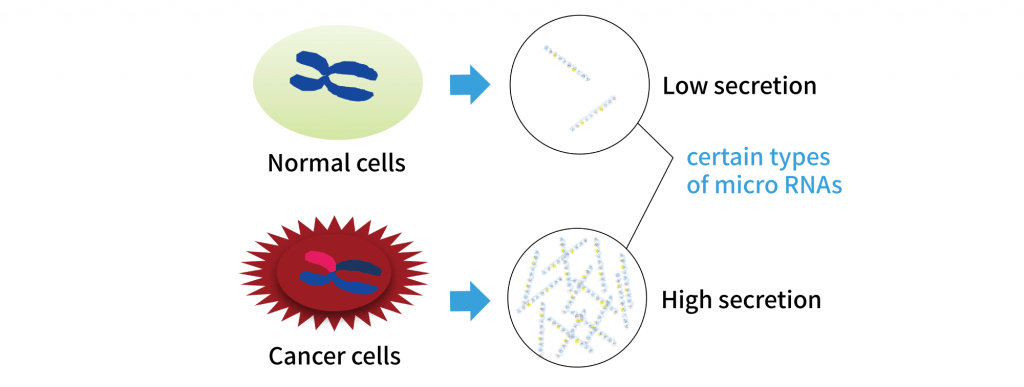
Detecting microRNAs that are increasingly secreted in cancer cells to determine whether cancer is present
The Birth and Expectations of microRNA Detection Technologies
At the beginning of the research, it was not so easy to successfully detect microRNAs. It took six years to develop this technology. Three years were spent to verify the principle mechanisms to detect micro-RNAs with high accuracy. The accuracy here means “the possibility that microRNAs are actually contained in samples judged positive (microRNAs exist).” Because it was so difficult to achieve the target accuracy, Hashimoto felt very anxious. “When can I measure microRNAs in the blood?” After many years, however, Hashimoto gained 99% accuracy as a result of his research, based on both daily trial and error and expertise he gained in DNA detection technology. He also succeeded in shortening the testing time and reducing the size of the device.
“Biotechnology research often takes a lot of time to obtain the necessary results. Our company acknowledged the significance of this research and allowed me to complete it to the end. With this, I reconfirmed that Toshiba is the true R&D company that strongly values technology and research.”
This technology brings us the possibility that we are able to test with a small amount of blood collected during a health checkup and to detect cancers at an ultra-early stage. It is also attractive to be able to test a large number of people simultaneously, as this technology enables us to get the results in 2 hours per test. 13 types of cancers are targeted at this time, and if positive, additional tests would be performed to identify which type of cancer it is.

Cancers targeted by microRNA detection technology
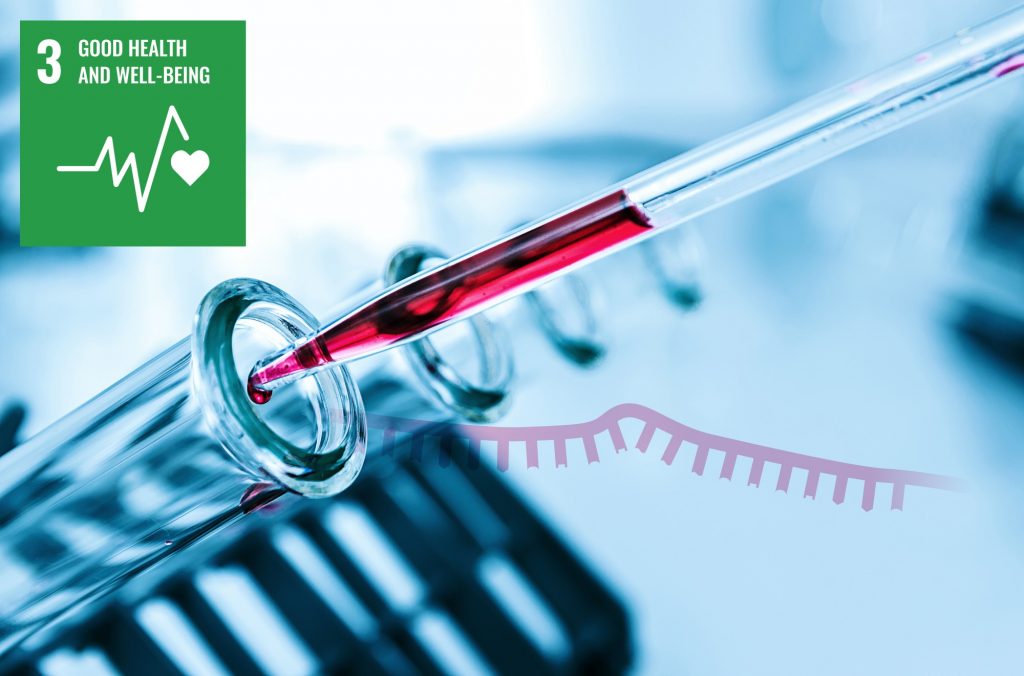
Toshiba aims to introduce microRNA detection technology in various types of medical examinations in order to increase the availability for more people to use it under the health insurance. In response to this effort, the Prize from the Minister of Economic, Trade and Industry of Japan evaluated that it is expected to contribute to “Ensure healthy lives and promote well-being for all at all ages” of the UN SDGs (Sustainable Development Goals). In addition to detecting cancer, the global development to the wide range of medical treatment including detections of diseases other than cancer is also promising.
“I would like to improve the remaining 1% of the 99% accuracy. We were able to find out that microRNAs are highly relevant to cancer, so combining multiple microRNAs may increase the detection accuracy and also allow us to distinguish cancer types”, says Hashimoto.
The progress of Toshiba’s research and development is still ongoing. Researchers and engineers are looking for a better way, and the technologies cultivated and inherited over years will turn on the promise of a new day in healthcare.