TOKYO—Toshiba Corporation (TOKYO: 6502) today announced an updated solid-state LiDAR that achieves the world’s smallest volume, robust vibration and wind resistance while maintaining a maximum detection range of 200m, plus the highest resolution of any sensor of similar size*. The upgraded performance of the new LiDAR will advance progress to autonomous driving, and also expand its application into monitoring transportation infrastructure, in such areas as early detection of road subsidence or landslides, snow cover, or falls of objects onto roads.
Current monitoring of transportation infrastructure relies on cameras, but their performance is degraded by low light and bad weather. Toshiba’s upgraded solid-state LiDAR is an excellent alternative, as it realizes clear, long-distance, robust 3D scanning and object detection in a wide variety of lighting and weather conditions. It is also extremely compact, with an overall volume of 350cc. It is only one-third the size of an earlier prototype announced in July 2020, and the industry’s smallest on record*.
“We look forward to deploying our technologies in roadside LiDAR,” said Akihide Sai, Senior Research Scientist at Toshiba’s Corporate Research & Development Center. “We have secured technologies essential for a compact, high-resolution, long-range solid-state LiDAR that is robust and simple to install. We anticipate demand for such a versatile technology in both the autonomous driving and transportation infrastructure monitoring markets.”
Toshiba achieved a compact LiDAR with higher image resolution through upgrades to its silicon photo-multiplier (SiPM), a light-receiving chip. An SiPM consists of light-receiving cells controlled by transistors. The new chip has a smaller transistor module, and eliminates the buffer layer that protected the transistors with newly developed insulating trenches between the transistors and the light-receiving cells. The potential issue of low light-sensitivity from using smaller transistors was solved with the addition of a high-withstand voltage section to raise the voltage input to the light-receiving cell (Figure 1).
These innovations have reduced the size of the SiPM by 75% while enhancing its light sensitivity by 50% against the July 2020 predecessor. More SiPM can now be arrayed in the same package, boosting resolution to 1,200 x 80 pixels, a 4-times improvement.
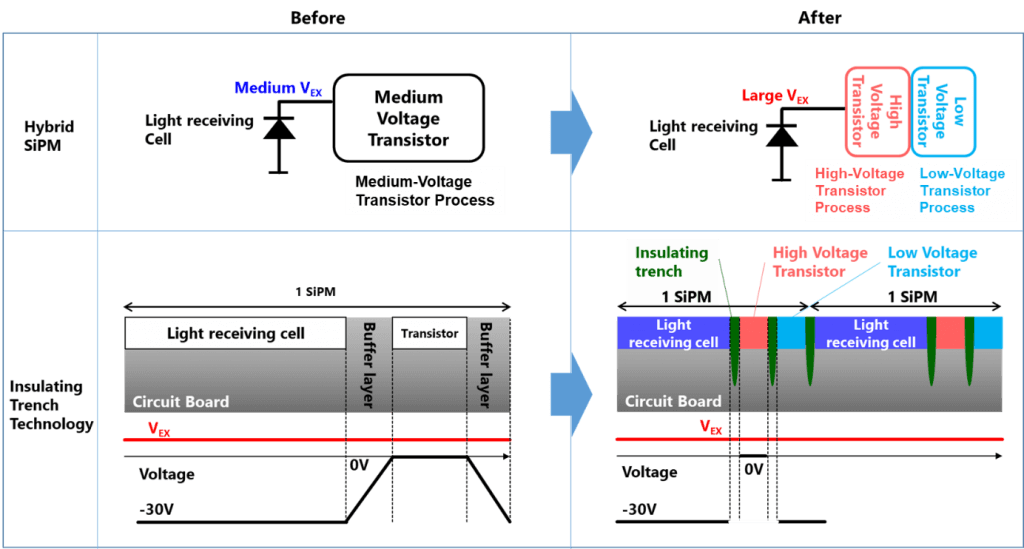
Figure 1: Toshiba’s new SiPM is implemented with smaller transistors, a high voltage input section, and insulating trenches.
Toshiba has also ensured that the new LiDAR unit has the durability essential for outdoor use in all weather conditions. Temperature compensation technology that automatically adjusts voltage input to the light-receiving cells reduces impacts from external temperature changes and maintains high level SiPM performance. In addition, by utilizing its know-how in high-density component mounting, Toshiba has reduced the overall size of the LiDAR projector and receiver to 350cc (Figure 2), and secured robust vibration and wind resistance. These advantages, plus world-beating high resolution, are expected to win wider application of the system.
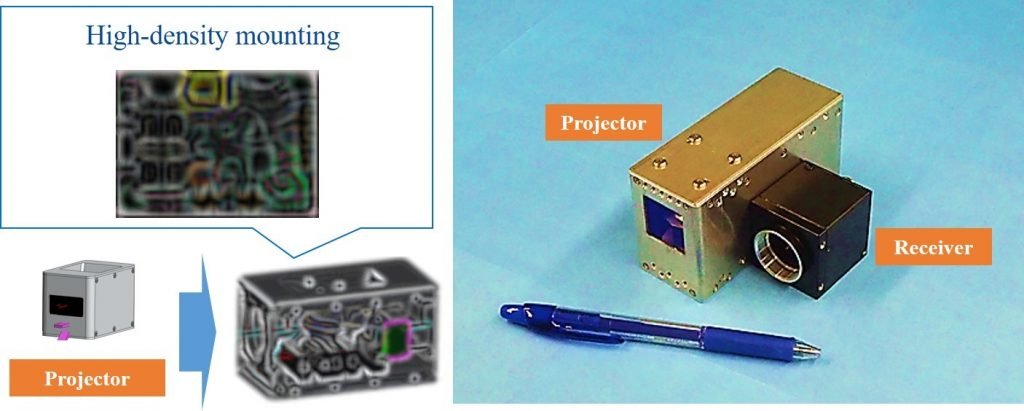
(Right) Toshiba’s LiDAR prototype is the world’s smallest, 350cc in volume.
Toshiba will continue to support safer transportation by promoting its LiDAR technologies for autonomous driving and transportation infrastructure monitoring. Continued R&D will further advance the LiDAR’s detection range, image resolution and miniaturization, and explore new applications in robots, drones, and small security devices.
*Toshiba survey.
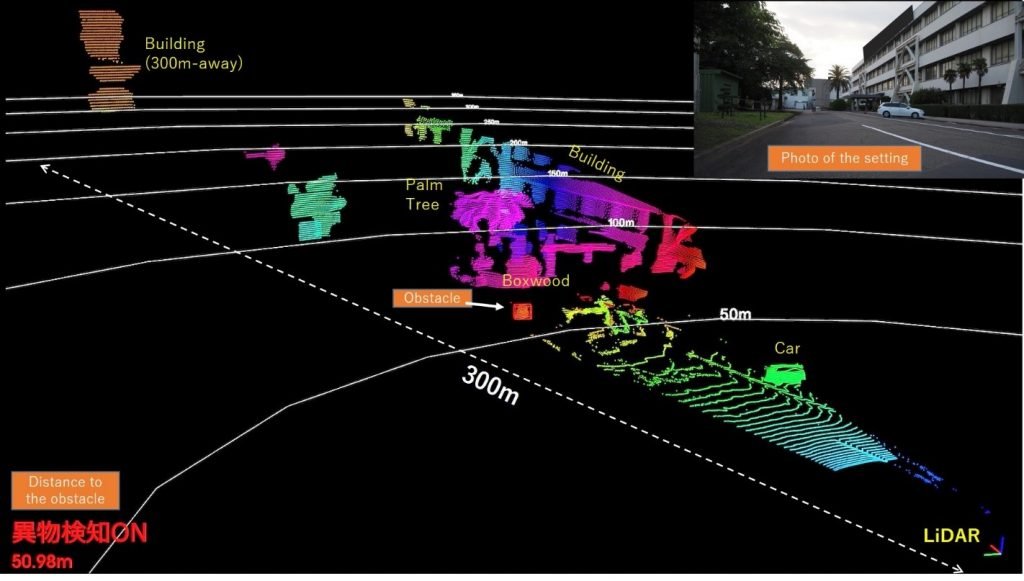
Figure 3: A demo of obstacle detection using Toshiba’s new LiDAR in an outdoor and sunny daytime setting. The LiDAR successfully circled a cardboard placed at 50m ahead and accurately measured the distance. (Low speed frame rate (1fps). Fixed angle. Detection range: ~ 300m)
Click below links for the demo videos.
Video 1: Toshiba’s new LiDAR provided a clearer detection of three obstacles in an outdoor and nighttime setting than a camera and an infrared camera. (Low speed frame rate (1fps). Fixed angle. Detection range: ~ 200m)
Video 2: Change the shooting angles and Toshiba’s new LiDAR can detect objects from a car parked at 20m ahead to a building located 300m ahead. (High speed frame rate (20fps). Change of angles. Detection range: 20~300m. Outdoor and sunny daytime condition.)